Paper 002: Low-Value Sector Budget as a Negative Invariant in Geometry-Aware Wormhole Transport
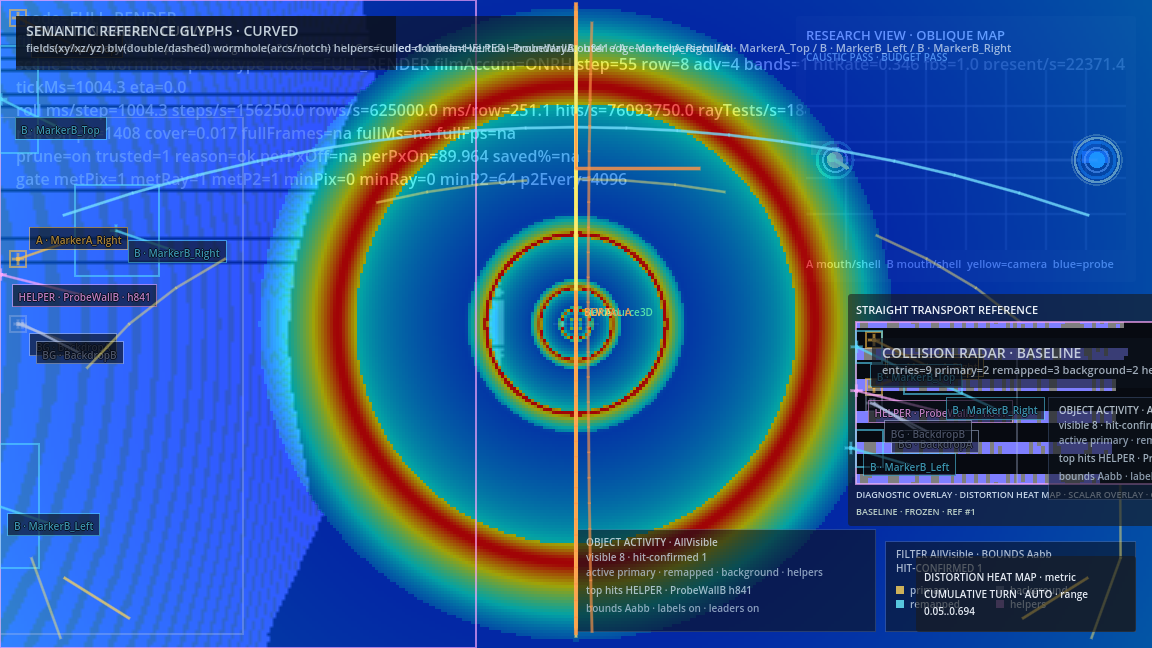
Current wormhole DualRealityTransport capture showing the curved main view, straight transport reference panel, and diagnostic overlays.
Abstract
We define a low-value sector budget as a negative invariant for deterministic wormhole rendering, complementing the proto-caustic annulus introduced in Paper 001. Whereas the proto-caustic invariant preserves a destination-side high-value optical structure, the present contract limits how much overlap-query work may continue to accumulate in portal-local sectors shown to have negligible contribution to the preserved image. Traditional ray tracing has little language for such a condition, since waste is usually measured globally through timing counters rather than geometrically through persistent low-yield regions. We demonstrate that the wormhole harness in GD_xPRIMEray admits a stable budget contract on a non-invariant outer-ring family and that a modest deterministic throttle reduces pass-2 query cost while preserving hits, final writes, and the annular structure defined previously. The result is a paired validation system in which geometry dictates not only what must be preserved, but also where expenditure should remain bounded.
1. Motivation
Paper 001 established that wormhole transport in this harness should not be judged merely by whether rays survive remap and reach film. It showed that a portal-local annulus on the destination side carries structured optical value: continuity, density, and radial separation that remain stable under deterministic runs. That result immediately raises a complementary question. If some regions are demonstrably rich in optical significance, are there others whose cost can be bounded without injury to the preserved structure?
Classical rendering practice usually answers such a question only indirectly. One measures global timing, samples fewer rays, or prunes heuristically, then asks whether the image appears worse. Such a method is too blunt for a wormhole scene. The transport is curved, remapped, and observer-dependent; it is easy to save time in the wrong place while leaving correctness under-specified. One needs a notion of negative structure: a region whose repeated expenditure can be shown to have low value relative to the maintained optical signature.
The deterministic harness already suggests such a region. Portal-sector usefulness mapping shows that a subset of outer-ring sectors on layer = 0, radial_bin = 3 accumulates heavy query traffic while contributing little or nothing to the preserved annulus and, in the strongest cases, no final hits at all. The question is not whether these sectors are metaphysically unimportant. It is whether the geometry permits their budget to be constrained without corrupting the observer-facing structure that transport is supposed to preserve.
The motivation of the present paper is therefore complementary to that of Paper 001. There the task was to identify a positive invariant: a high-value annulus that must survive. Here the task is to identify a negative invariant: a low-value region whose query share must not be allowed to grow beyond an explicit bound. Meaningful rendering requires both. Together they begin to define not only where wormhole optical reality concentrates, but also where computation may be prevented from dissipating into regions that do not materially support that concentration.
2. Related Work
2.1 Importance sampling and geometric budget allocation in rendering
Conventional rendering addresses the question of where to spend computation through importance sampling. Veach and Guibas (1995) showed that multiple importance sampling (MIS) can combine estimators from different distributions optimally by weighting each in proportion to its contribution to the integrand. The low-value sector budget is the geometry-aware, deterministic counterpart of this idea: instead of sampling proportional to an estimated BSDF–light product, xPRIMEray allocates pass-2 query work in proportion to a measured portal-local optical yield — and explicitly bounds the work allocated to sectors whose yield has been shown to be negligible across deterministic runs.
Pharr, Jakob, and Humphreys (2023) discuss adaptive sampling in the context of metropolis transport and light-tracing estimators. The conceptual innovation here is that the "importance" metric is not drawn from a scene's static light distribution, but from the geometric structure of the wormhole transport itself — specifically, the portal-local sector map that identifies which angular and radial regions carry the proto-caustic signal.
2.2 Low-information regions in gravitational optics
The geometric analog in relativistic optics is the shadow of a black hole: the region of the image plane that receives no null geodesics because all rays with impact parameter below the critical value \(b_c = 3\sqrt{3}M\) are captured. The Event Horizon Telescope Collaboration (2019) demonstrated that this shadow is observationally stable — the low-information region of the image is well-defined and persistent, not a measurement artifact.
In xPRIMEray's wormhole scene, the low-value outer-ring sectors play the corresponding role: they are the transport-geometry-defined low-information region of the portal image plane. The negative invariant contractualizes this observation: once a sector family has been shown to accumulate cost without yield across deterministic runs, bounding its share is not a heuristic — it is a geometric statement about where the effective optical potential of the GRIN field does not concentrate rays.
Broderick and Loeb (2006) showed that sector-level analysis of near-horizon emission patterns can distinguish physically meaningful features from imaging artifacts. The sector heatmap methodology in xPRIMEray parallels this analysis in the rendering domain.
2.3 The dual invariant structure in relation to the Gordon metric
The positive invariant (Paper 001) and negative invariant are jointly grounded in the Gordon-metric description of the GRIN transport. Gordon (1923)'s result implies that the effective optical potential of the portal GRIN field concentrates null-ray density into a caustic-like annulus on the destination side and creates a shadow-like depletion zone on the outer ring. These are two faces of the same focusing geometry: the inner ring is bright because rays converge there; the outer ring is dark because they do not.
The dual invariant system therefore has a single physical source. The positive invariant measures the focused region; the negative invariant bounds the unfocused region. Together they bracket the correct operating regime of the renderer in a way that neither alone can achieve.
This structure resonates with the lensing literature (Schneider, Ehlers, and Falco, 1992): the caustic and the shadow boundary are dual features of the same lens mapping, and both must be correctly reproduced for the lens model to be valid.
3. Concept: Low-Value Sector Budget
The low-value sector budget is a portal-local, region-specific constraint on query allocation. The scene is partitioned into sectors by portal-local coordinates, in particular:
layerradial_bintheta_bin
Within this partition, the low-value family of interest is the outer-ring region:
layer = 0radial_bin = 3
Usefulness mapping then identifies a retained throttle profile inside that family:
theta bins = {13,14,15,0}period = 2
The negative invariant is defined by a simple contract:
actual_query_share <= maximum_allowed_query_share
where the allowed share is derived from a deterministic baseline:
baseline_query_share = 0.4011max_query_share_scale = 0.9maximum_allowed_query_share = 0.361
This is not merely a timing budget renamed in geometric language. It is a geometric-statistical constraint. The sectors are portal-local. The classification is grounded in measured query work and measured yield. The contract is evaluated only in tandem with preservation of the positive annulus invariant from Paper 001.
One may therefore describe this as geometric pruning in a disciplined sense. The system does not discard a region because it looks empty in one frame. It bounds expenditure because a sector family has been shown, across deterministic runs, to contribute disproportionately little to the preserved optical structure. The suppression is structural rather than heuristic.
In the present harness, the meaning of the budget is straightforward: the outer-ring low-value family must not reclaim too much of the pass-2 query budget once geometry has shown that its optical yield is weak. The constraint therefore complements the proto-caustic invariant. One preserves the annulus where signal concentrates; the other bounds the sectors where cost continues but significance does not.
3. Method
The method reuses the deterministic wormhole harness established for Paper 001. Camera transform and input are fixed. Pass-1 transport advances rays through the GRIN field. Boundary interaction triggers remap between scenes. Pass-2 performs candidate generation and OverlapOnly query dispatch before narrowphase hit resolution and film write. No change to transport law, remap logic, broadphase policy, or hit acceptance is introduced for the purposes of the present paper.
The additional ingredient is sector heatmap measurement and budget evaluation. Post-remap segments are aggregated into portal-local bins indexed by:
- layer
- radial bin
- theta sector
- direction bucket when available
For each class, the harness records:
- query count
- geometry hit count
- final-write relevance
- relation to the invariant annulus
- share of total query work
This makes it possible to identify high-cost, low-yield sectors and to distinguish them from sectors that materially support the preserved annulus. The low-value sector budget is then evaluated as a deterministic contract after each harness run. In implementation terms, this evaluation is emitted by WormholePrototypeRig and written into the saved report fields:
low_value_sector_budget_contractlow_value_sector_budget_result
The active kept throttle profile remains deliberately narrow. It does not remove the low-value sectors. It reduces overlap-query frequency deterministically within a known outer-ring family:
layer = 0radial_bin = 3theta bins = {13,14,15,0}period = 2
As in Paper 001, the figure quartet serves as the common evidence frame:
- Figure A: raw film-buffer result
- Figure B: composed render with research inset
- Figure C: portal-local density structure
- Figure D: compact metrics and contract summary
The method is therefore not a detached optimization study. It is a continuation of the same invariant-driven measurement language, now extended from preservation to bounded suppression.
4. Results
The results should again be read as coordinated views of one underlying structure.
Figure A

Figure A shows the raw film result under the active kept low-value throttle profile. Its role here is contextual. The image must remain stable not because it is pleasing in the abstract, but because the budget contract has value only if the observer-facing output remains intact.
Figure B
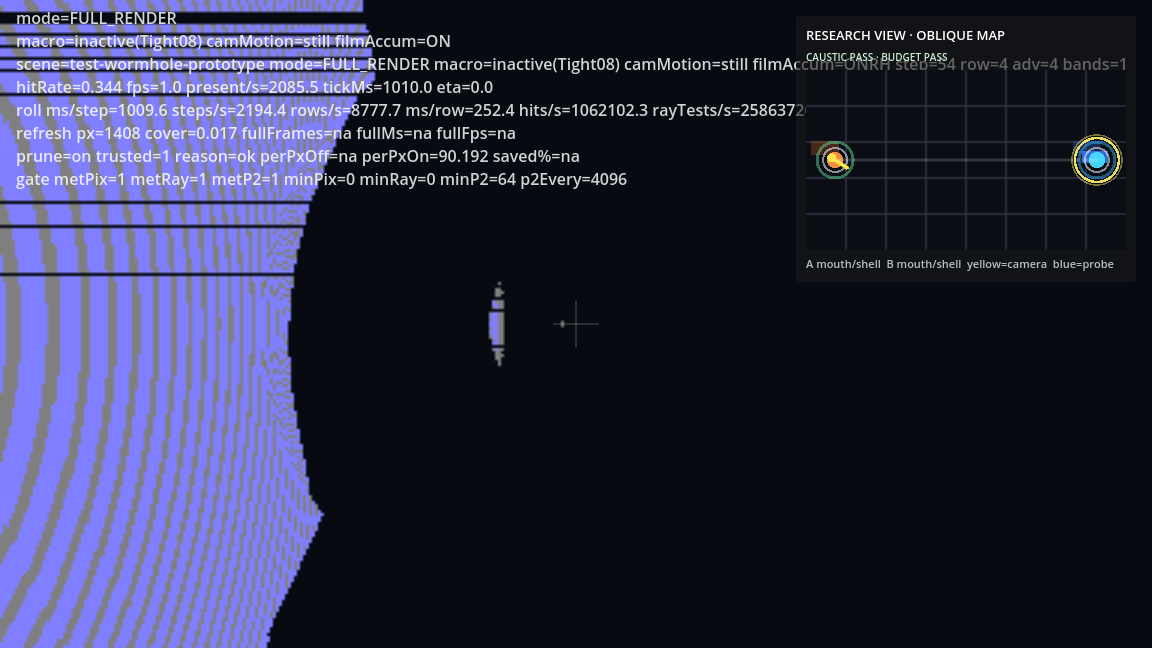
Figure B restores explanatory structure. The research inset indicates the active mode, the contract status, and the highlighted invariant ring. The low-value budget is therefore shown in its proper relation to the annulus preserved by Paper 001.
Figure C

Figure C is especially important in the present paper. It makes visible the portal-local distribution within which the negative invariant is meaningful. The outer-ring low-value sectors appear as regions in which cost is not matched by comparable contribution to the preserved annulus, while the destination-side annular concentration remains prominent. The geometry thus distinguishes between expenditure that sustains structure and expenditure that mostly accumulates outside it.
Figure D

Figure D closes the loop quantitatively. It records the proto-caustic invariant status, the low-value sector budget status, the active throttle profile, and the key pass-2 timing metrics. It also makes the budget margin visible. For the current kept profile, the relevant values are:
actual low-value query share = 0.2888maximum allowed query share = 0.361- budget margin =
0.0722
The central empirical result is therefore twofold. First, low-value regions are not merely asserted; they are measured through query share and yield. Second, bounded suppression of those regions reduces waste without disturbing the annular structure that Paper 001 treats as geometrically significant.
5. Validation
Validation in this paper is intentionally explicit and falsifiable. The negative invariant passes only if:
actual_query_share <= maximum_allowed_query_share
For the current kept profile, the measured example is:
actual_query_share = 0.2888maximum_allowed_query_share = 0.361- budget margin =
0.0722
This margin matters. It indicates that the retained throttle profile does not merely scrape beneath threshold; it preserves a nontrivial buffer while leaving geom_hits and final_write_px unchanged.
The negative invariant is not evaluated in isolation. It is paired with the proto-caustic annulus contract from Paper 001. A run is acceptable only if:
- the destination-side annulus preserves hit density, hit continuity, positive-overlap continuity, and radial gradient above threshold
- the low-value family remains below its maximum allowed query share
Failure therefore has a clear meaning. It would appear either as oversampling of low-significance sectors, as re-expansion of their query share, or as disturbance to the preserved annulus and the final observer-facing output. In practical terms, oversampling noise regions risks degrading the clarity of the wormhole’s structured focusing behavior even if some gross timing metric appears to improve.
The rejected stronger throttle boundary is equally informative. Increasing the same low-value family from period = 2 to period = 3 still passed the formal contracts, but it weakened annular metrics, worsened the target timing buckets, and reduced geom_hits and final_write_px. This shows that the negative invariant is necessary but not sufficient: retained configurations must satisfy the budget contract, preserve the positive invariant, and avoid hit/write drift.
6. Discussion
The significance of the low-value sector budget lies in the emergence of a dual invariant system. Paper 001 supplies the positive invariant: preserve a geometrically meaningful annulus. Paper 002 supplies the negative invariant: limit expenditure in portal-local sectors whose recurrent yield is low. The pair is more powerful than either component alone.
This duality is geometric and statistical at once. Geometry defines the partition and reveals the annulus. Statistics measure density, continuity, and query share within that partition. Efficiency then emerges not from an externally imposed heuristic, but from constraints imposed by measured structure itself. One does not guess where to save work; one learns where cost is recurrently uninformative.
A restrained observer-aware reading is available here as well. The system does not become intelligent in any anthropomorphic sense. But it does begin to self-organize toward informative regions. It protects the annulus where optical significance concentrates and limits the expansion of sectors whose repeated cost does not materially support the visible result. In that narrow but meaningful sense, the rendering process becomes shaped by contracts rather than by tuning knobs.
This matters for future adaptive rendering work. A renderer that preserves signal without suppressing low-value expenditure remains incomplete. A renderer that suppresses cost without preserving optical structure is equally incomplete. The dual invariant system suggests a more disciplined path: adaptive logic should be judged by whether it keeps the geometry’s concentrations intact while bounding the branches that remain computationally active but optically weak.
7. Conclusion
We defined a low-value sector budget as a negative invariant that constrains pass-2 expenditure in a portal-local outer-ring family.
We showed that the deterministic wormhole harness can retain a modest geometry-aware throttle that improves the target timing buckets while preserving hits, final writes, and the proto-caustic annulus.
This matters because invariant-driven rendering now includes both preservation of signal and suppression of waste, turning measured structure into a behavioral contract rather than a post hoc diagnostic.
References
| Key | Citation |
|---|---|
| [gordon1923] | Gordon, W. (1923). Zur Lichtfortpflanzung nach der Relativitätstheorie. Annalen der Physik, 377(22), 421–456. |
| [plebanski1960] | Plebański, J. (1960). Electromagnetic waves in gravitational fields. Physical Review, 118(5), 1396–1408. |
| [leonhardt_philbin2009] | Leonhardt, U. & Philbin, T.G. (2009). Transformation optics and the geometry of light. Progress in Optics, 53, 69–152. |
| [morris_thorne1988] | Morris, M.S. & Thorne, K.S. (1988). Wormholes in spacetime and their use for interstellar travel. American Journal of Physics, 56(5), 395–412. |
| [eht2019] | Event Horizon Telescope Collaboration (2019). First M87 Event Horizon Telescope Results. I. Astrophysical Journal Letters, 875(1), L1. |
| [bozza2002] | Bozza, V. (2002). Gravitational lensing in the strong field limit. Physical Review D, 66, 103001. |
| [broderick_loeb2006] | Broderick, A.E. & Loeb, A. (2006). Imaging optically-thin hotspots near the black hole horizon of Sgr A. Monthly Notices of the Royal Astronomical Society*, 367(3), 905–916. |
| [schneider1992] | Schneider, P., Ehlers, J. & Falco, E.E. (1992). Gravitational Lenses. Springer-Verlag. |
| [pharr2023] | Pharr, M., Jakob, W. & Humphreys, G. (2023). Physically Based Rendering (4th ed.). MIT Press. |
| [kajiya1986] | Kajiya, J.T. (1986). The rendering equation. ACM SIGGRAPH Computer Graphics, 20(4), 143–150. |
| [veach_guibas1995] | Veach, E. & Guibas, L.J. (1995). Optimally combining sampling techniques for Monte Carlo rendering. ACM SIGGRAPH, 419–428. |
| [james2015] | James, O., von Tunzelmann, E., Franklin, P. & Thorne, K.S. (2015). Gravitational lensing by spinning black holes in astrophysics, and in the movie Interstellar. Classical and Quantum Gravity, 32(6), 065001. |
| [chan2013] | Chan, C.-K., Psaltis, D. & Özel, F. (2013). GRay: A massively parallel GPU-based code for ray tracing in relativistic spacetimes. Astrophysical Journal, 777(1), 13. |
Full BibTeX: ../shared_bibliography.bib
Appendix A
Current deterministic harness configuration for the active low-value sector budget and companion annulus invariant:
LowValueSectorBudgetLayer = 0LowValueSectorBudgetRadialBin = 3LowValueSectorBudgetBaselineQueryShare = 0.4011LowValueSectorBudgetMaxQueryShareScale = 0.9maximum_allowed_query_share = 0.361- active kept low-value throttle profile:
layer = 0radial_bin = 3theta bins = {13,14,15,0}period = 2- companion proto-caustic target ring:
layer = 1radial_bin = 3- proto-caustic thresholds:
min_hit_density = 800min_hit_continuity_ratio = 0.95min_positive_overlap_continuity_ratio = 0.95min_radial_gradient = 600