Causal Observer Ladders for Wormhole Ray Transport
Fresh-Instance Validation, Regime Structure, and Bridge Anomalies
Abstract
We present a fixture-based method for validating observer-dependent ray transport through wormhole-like topological structures. Using a fresh-instance observer ladder with per-checkpoint causal verification, we identify distinct transport regimes spanning near-side, throat, bridge, and far-side observer states.
We demonstrate that world-space interpolation fails across the topological transition, while a mixed strategy of interpolation and discovered checkpoints yields a coherent traversal path. Derived metrics including optical path length (OPL), interaction density, and transport cost reveal a previously uncharacterized bridge regime in which interaction density collapses while per-crossing cost peaks. These results suggest that observer position defines transport regime and that naive coordinate interpolation is insufficient across non-trivial topology.
1. Introduction
Simulating ray transport through curved or topologically non-trivial spaces presents challenges beyond standard geometric rendering. In particular, observer-dependent effects may induce discontinuities that are not captured by naive interpolation in world-space coordinates.
This work introduces a causal observer ladder methodology: a sequence of validated observer states, each computed under fresh-instance conditions, ensuring that transport metrics reflect true causal structure rather than accumulated simulation artifacts.
We apply this method to a wormhole-like system and show that traversal naturally separates into multiple regimes with distinct transport characteristics.
2. Method
2.1 Fresh-Instance Observer Ladder
Each checkpoint is evaluated using a fresh instance of the renderer, ensuring: - full classified pixel coverage - zero budget exhaustion - zero inferred classification artifacts
This guarantees that differences between checkpoints arise from transport structure rather than simulation state.
2.2 Ladder Construction
The observer ladder consists of six validated checkpoints:
mouthmouth_to_throat_approachthroatpost_throat_backstep_01post_throat_exit_approachexit_lookback
Near-side checkpoints were densified via interpolation, while hard-leg checkpoints were discovered via guided search.
2.3 Derived Metrics
For each checkpoint, we compute:
- Optical Path Length (OPL mean, max)
- Portal-hit density
- Throat-event density
- Crossings per pixel
- Segments per crossing
- Average segments per ray
3. Results
All checkpoints satisfy full classified coverage, zero budget exhaustion, and zero inferred throat classification, ensuring that reported differences arise from transport structure rather than sampling artifacts.
3.1 Near-Side Regime
From mouth to throat, interaction density increases while transport cost decreases:
- portal-hit density: 0.1465 → 0.1750
- throat-event density: 0.0969 → 0.1139
- crossings per pixel: 0.6495 → 0.7479
- OPL mean: 9.9599 → 9.5078
- segments per crossing: 153.26 → 128.17
This indicates a smooth, interpolation-friendly regime.
3.2 Throat as Transition Hinge
The throat behaves as a transition hinge rather than a discontinuity, extending the near-side trend instead of breaking it.
3.3 Bridge Regime
The checkpoint post_throat_backstep_01 exhibits a distinct transport state:
- portal-hit density: 0.0964
- throat-event density: 0.0555
- crossings per pixel: 0.2098
- segments per crossing: 366.03 (maximum)
- OPL mean: 7.5908 (minimum)
This indicates a sparse, high-cost transport regime where interactions are rare but expensive.
3.4 Far-Side Re-Densification
The far-side regime re-densifies:
- throat-event density peaks at 0.2111
- crossings per pixel peaks at 1.6544
- segments per crossing drops to 50.31 (minimum)
At exit_lookback, portal density reaches its maximum (0.2557), and OPL max reaches 16.3070.
4. Key Findings
- Interpolation validity is regime-dependent
- The throat is not the primary discontinuity
- The bridge is the dominant transport anomaly
- OPL and interaction density decouple sharply at the bridge
5. Advanced Analysis of Observer Regimes
5.1 Regime Clustering Results
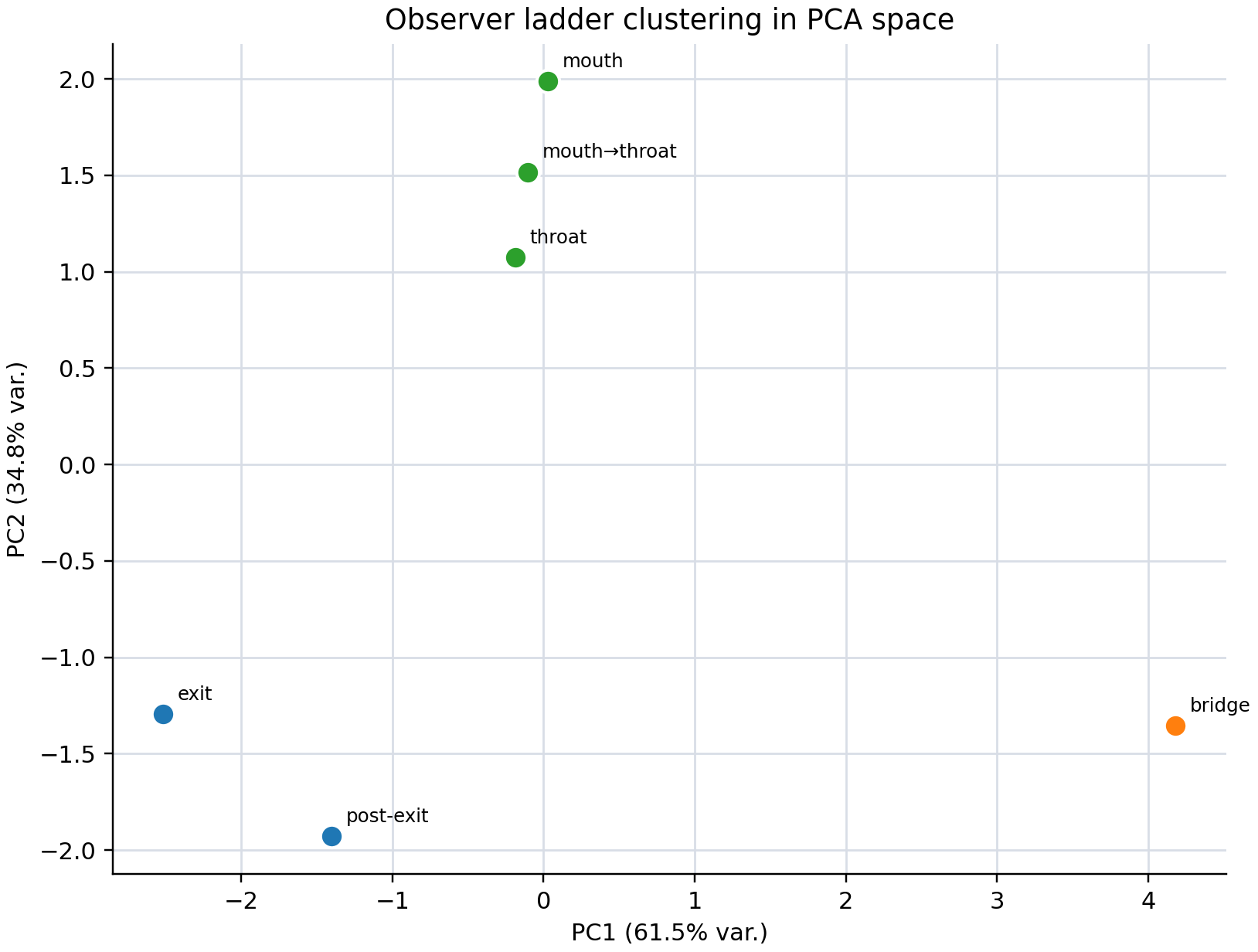
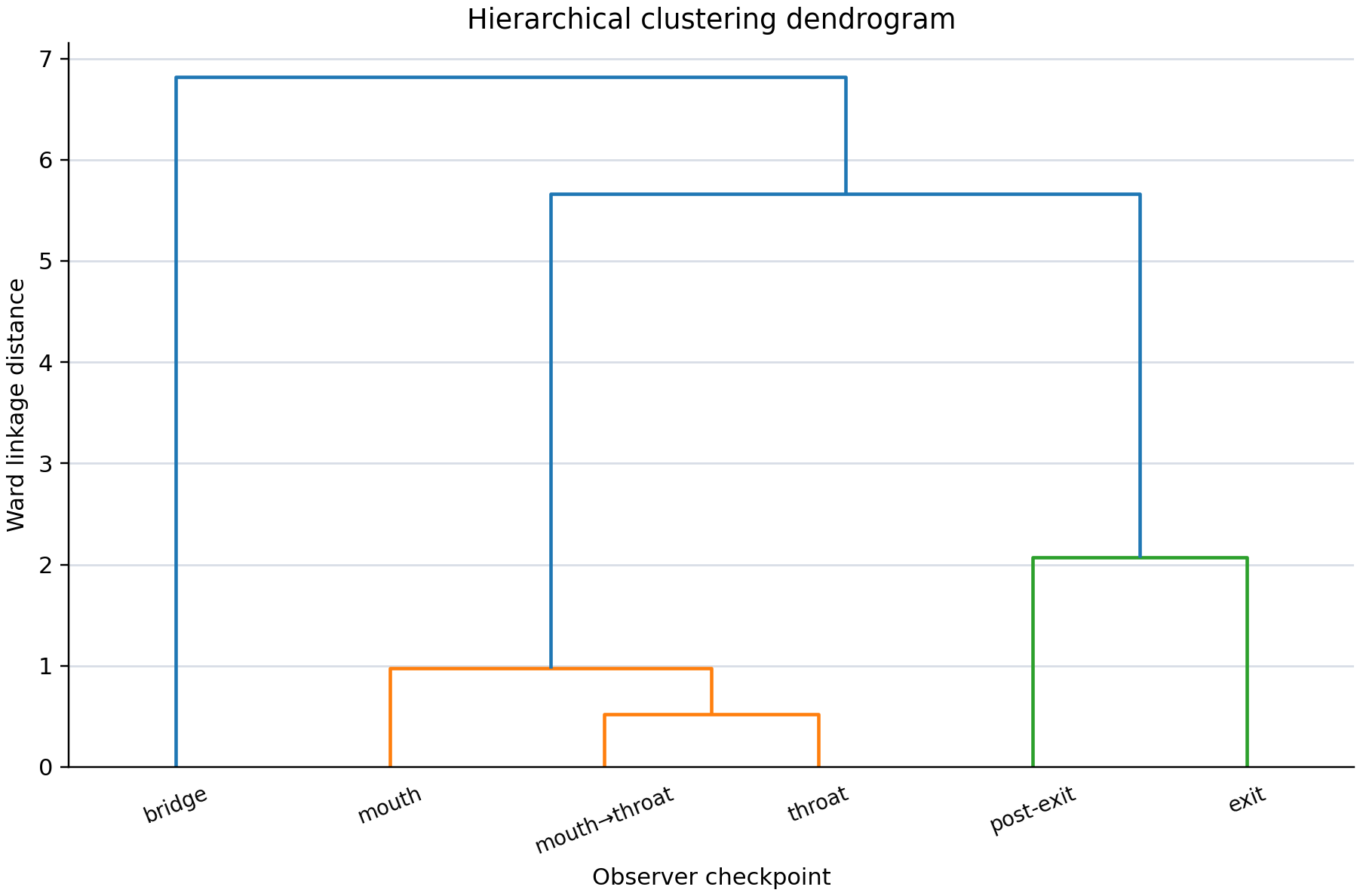
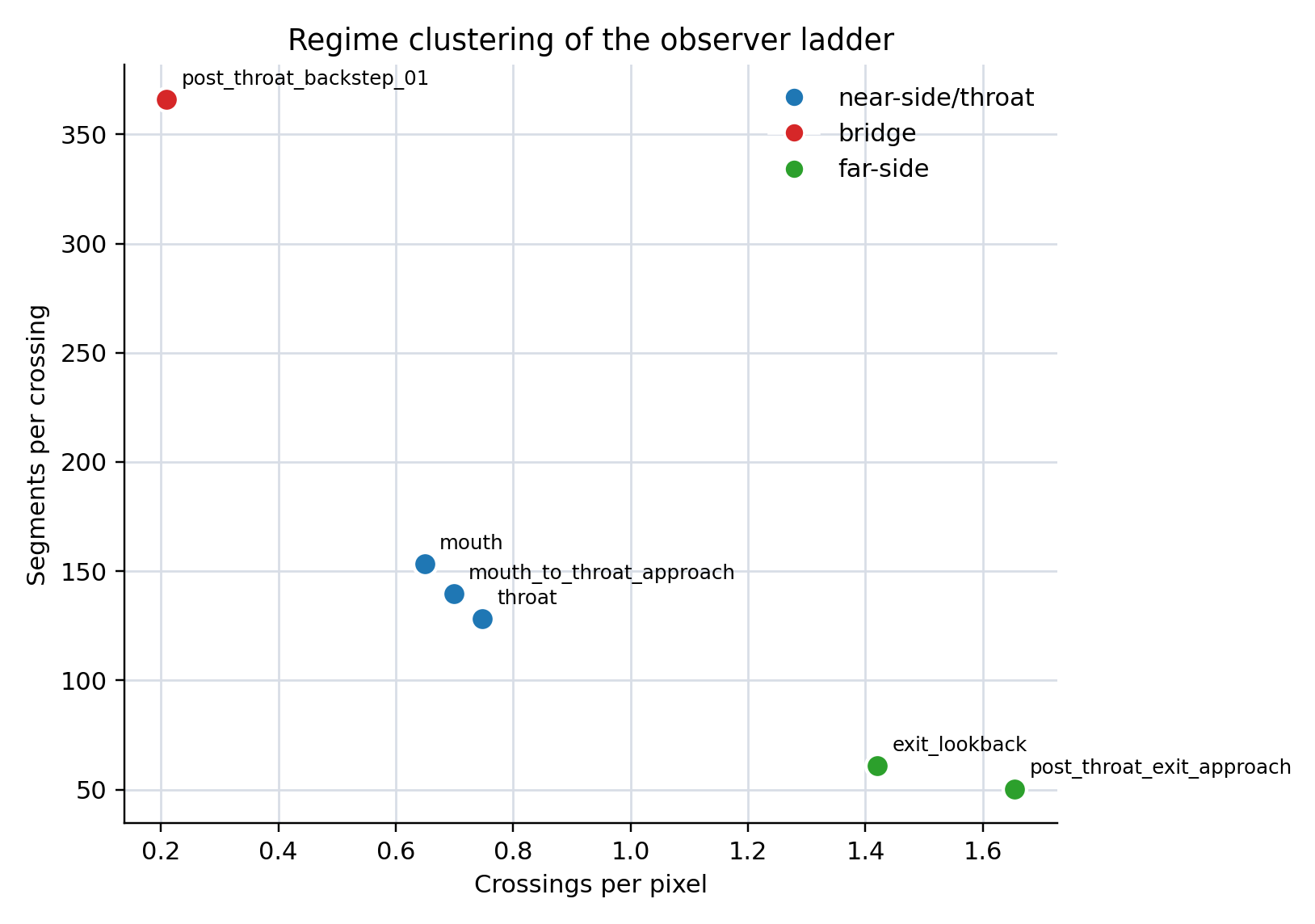
Artifact-only clustering recovered the large-scale observer-regime structure directly from the validated ladder metrics. Using standardized checkpoint features derived from optical path length, interaction density, crossing density, and transport cost, both agglomerative clustering and k-means achieved their best agreement with the manual regime labels at k = 3 (ARI = 0.5946, silhouette = 0.5547). In this best-performing automatic partition, the near-side checkpoints mouth, mouth_to_throat_approach, and throat were grouped together, the bridge checkpoint post_throat_backstep_01 was isolated as a singleton cluster, and the far-side checkpoints post_throat_exit_approach and exit_lookback formed a separate cluster. Thus, the bridge emerges automatically as a distinct transport state, whereas the throat is grouped more naturally with the near-side progression than with the bridge or far-side states.
This clustering result supports a physically interpretable regime decomposition. The near-side and throat checkpoints behave as a continuous interaction-rich family, while the bridge is separated by its sparse and inefficient transport signature rather than by a purely geometric label. The far-side states then regroup into a higher-density family with strong interaction load but lower transport cost per crossing.
Relevant figures: - cluster_pca_scatter.png - cluster_dendrogram.png - regime_clustering.png
5.2 Bridge Anomaly Quantification
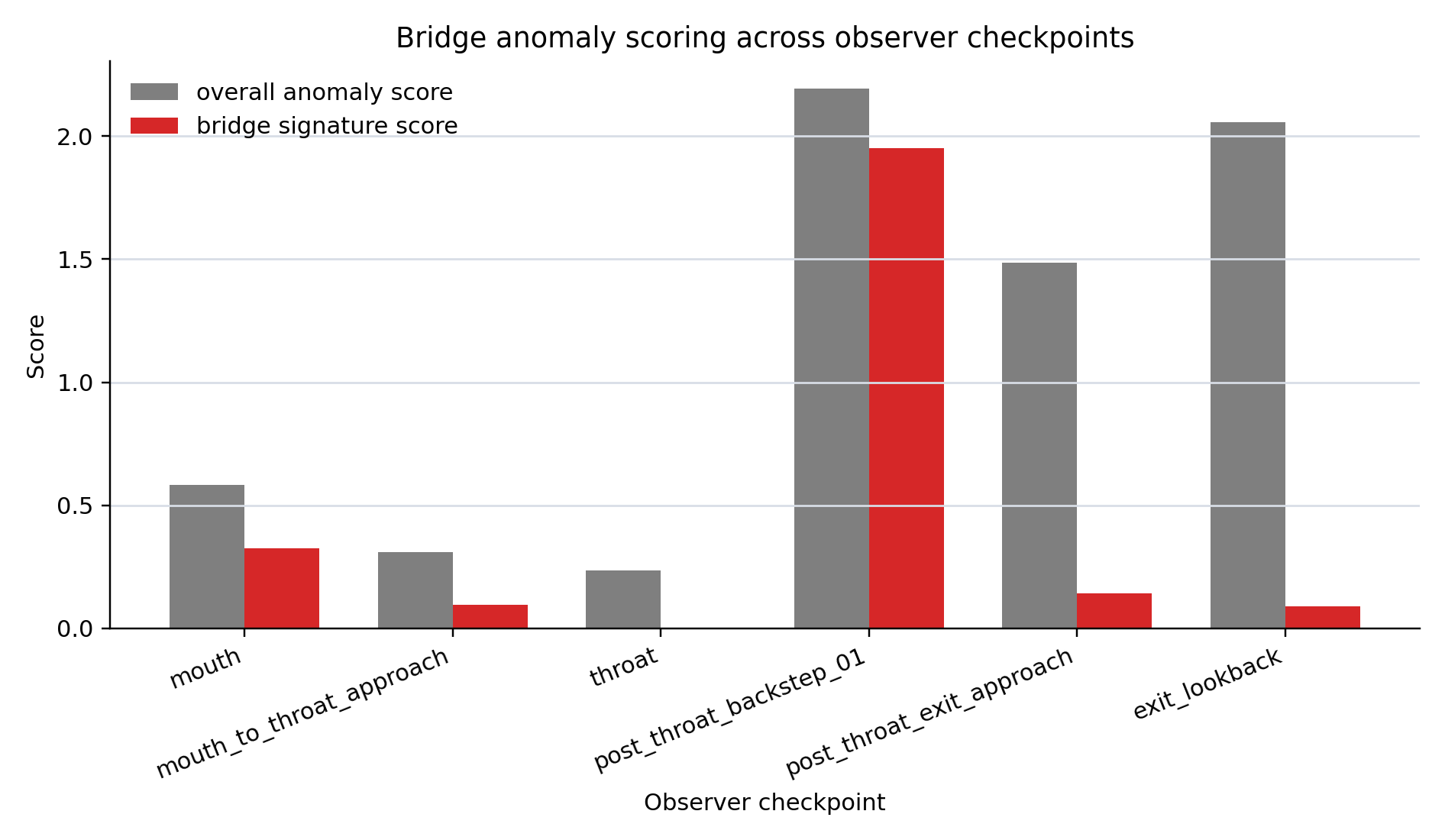
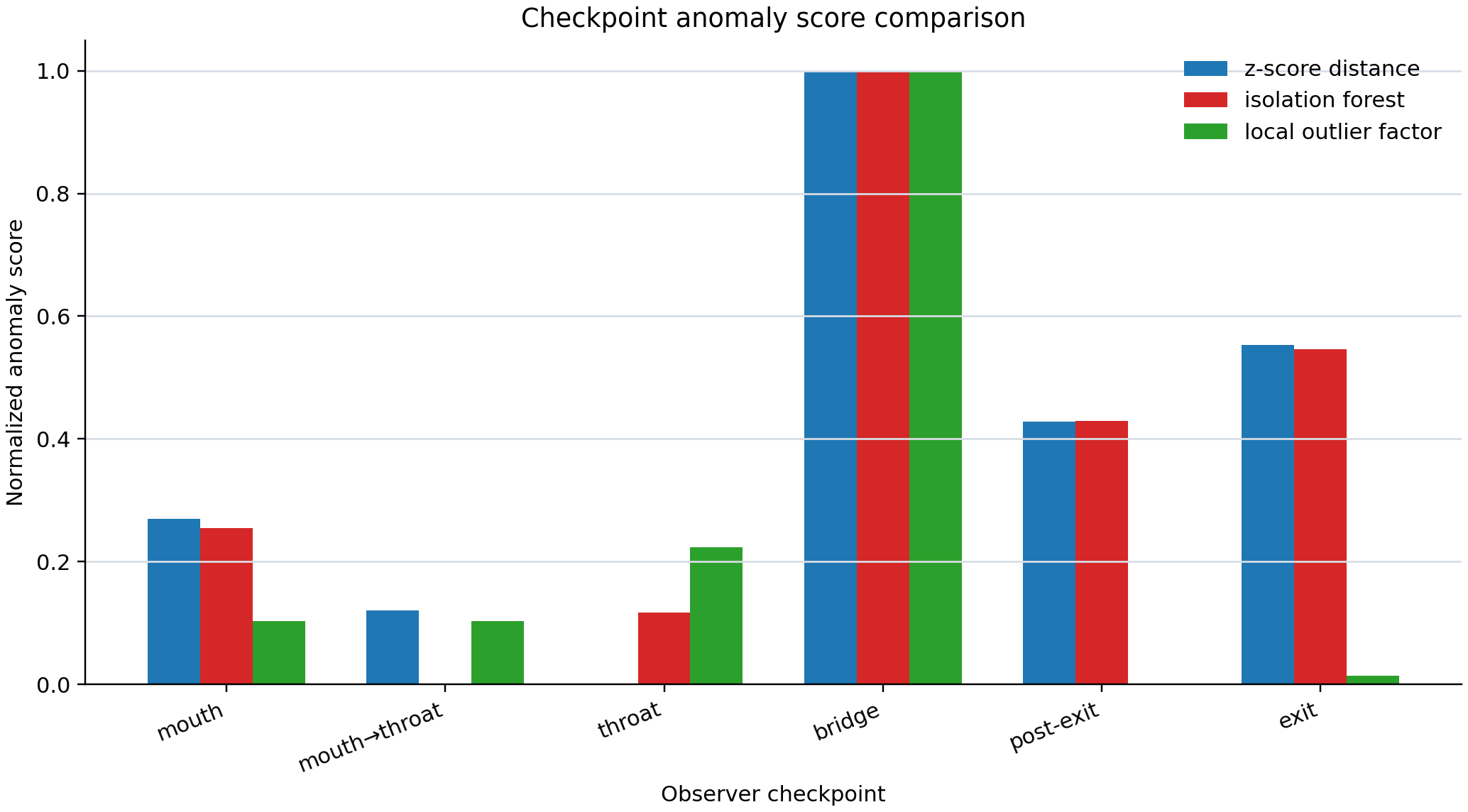
Three independent anomaly measures were applied to the same normalized checkpoint feature table: Euclidean z-score distance in standardized feature space, isolation forest, and local outlier factor. All three ranked post_throat_backstep_01 as the strongest anomaly in the ladder. In the combined ranking, the bridge checkpoint achieved the top position with z = 4.3999, isolation forest = 0.6160, and LOF = 1.3496, exceeding all other checkpoints across the joint anomaly assessment. The next-ranked checkpoints, such as exit_lookback and mouth, remained distinctly less extreme in the combined score.
The anomaly ranking provides quantitative support for the bridge interpretation already suggested by the observer-ladder characterization. The bridge is not merely a low-density checkpoint; it is a multi-metric outlier defined simultaneously by suppressed interaction density, depressed mean optical path length, and unusually high cost per crossing. In physical terms, this supports treating the bridge as a transitional transport anomaly rather than as a weak member of either the near-side or far-side regime.
Relevant figures: - bridge_anomaly_scores.png - checkpoint_anomaly_scores.png
5.3 Radial Structure and Horizon-Like Features
Image-derived radial structure analysis was performed using the approved debug captures and the previously estimated aperture centers. For each checkpoint, radial intensity profiles were reconstructed and differentiated to obtain first- and second-derivative structure, allowing detection of local peaks, inflection points, and sign changes near the apparent aperture radius. The resulting feature-radius comparison yielded a mixed global verdict: a single consistent feature radius does not persist across the entire ladder. However, near-side checkpoints remain relatively close to the marked aperture radius, and the throat checkpoint shows the strongest local slope magnitude near the apparent radius (0.0251), exceeding all other checkpoints.
This pattern suggests that a horizon-like radial feature is most sharply expressed at the throat rather than at the bridge. The near-side leg preserves a relatively stable radial boundary interpretation, while post-throat checkpoints increasingly shift away from a simple single-ring model. The bridge therefore appears not as the sharpest horizon-like state, but as the point where the visible radial structure becomes harder to represent with a single near-aperture feature radius.
Relevant figures: - normalized_profile_overlay.png - radial_derivative_panels.png


5.4 Spectral / Periodicity Analysis
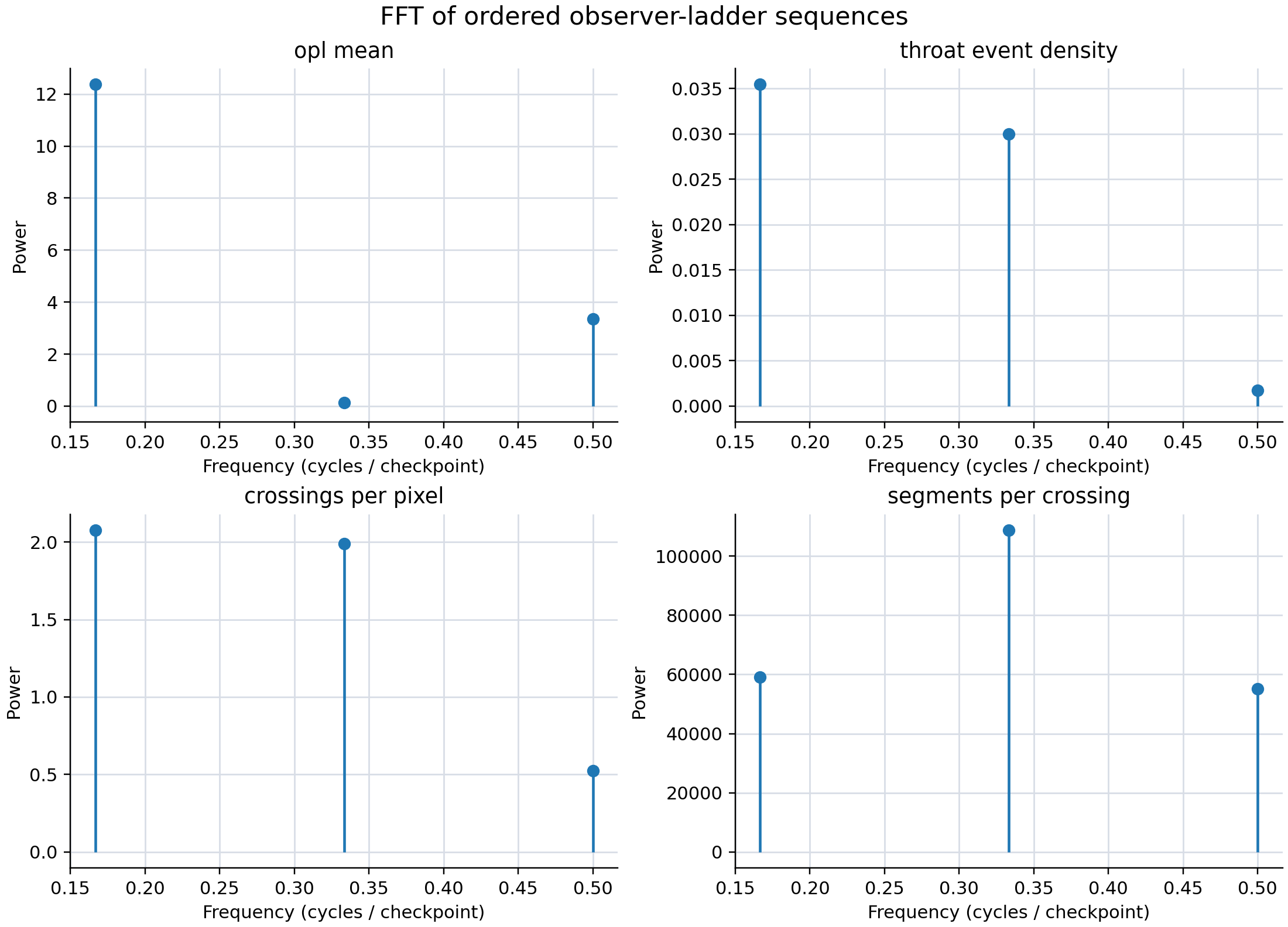
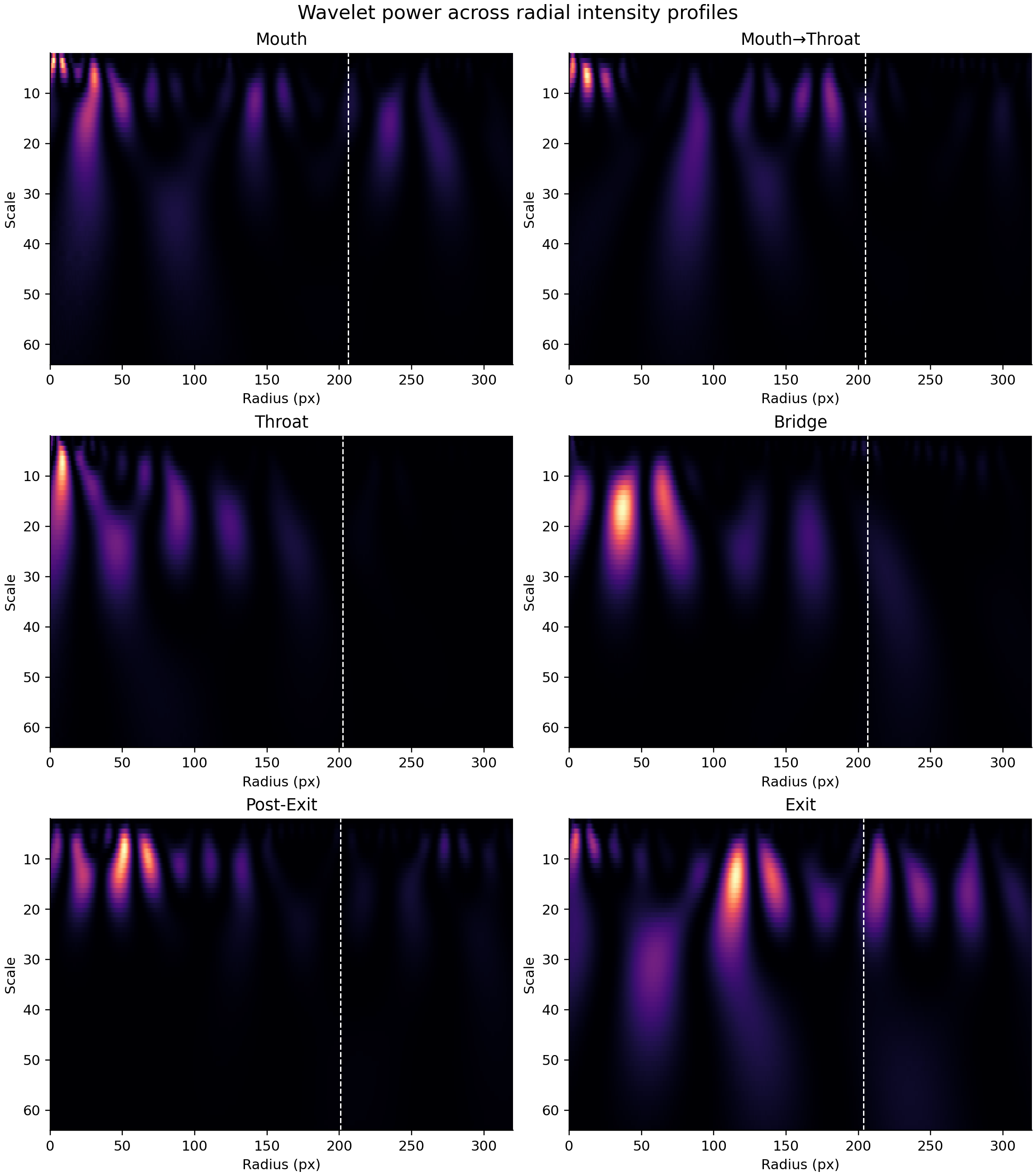
FFT analysis of the ordered ladder sequences was applied to OPL mean, throat_event_density, crossings_per_pixel, and segments_per_crossing. Across the first three sequences, the dominant frequency was the lowest nonzero mode (1/6 cycles per checkpoint), indicating a slow regime-scale drift rather than a repeating oscillation. segments_per_crossing showed a different dominant frequency (1/3 cycles per checkpoint), but the bridge residual remained large and localized, especially for segments_per_crossing, where the bridge deviation from neighbor interpolation was strongly positive. Wavelet analysis of the debug-image radial profiles also showed structured multiscale content, but the dominant scales changed across checkpoints rather than locking into a persistent repeating cadence.
Taken together, the spectral evidence argues against interpreting the ladder as an oscillatory family. Instead, the observer path is better described as a sequence of regime transitions with one strongly singular bridge excursion. In physical terms, the bridge behaves like a localized topological transition state rather than one phase of a smooth repeating pattern.
Relevant figures: - sequence_fft.png - radial_profile_wavelets.png
5.5 Geometric Sampling Texture and Orientation Persistence
Artifact-only geometric sampling analysis compared adaptive square tiles, polar/radial tiles, OpenCV/scikit-image morphology detections, and log-polar edge-orientation histograms. Adaptive square tile boundaries were the stronger directional boundary match: for the available mouth and post_throat_backstep_01 diagnostics, adaptive boundary overlays reached gradient-direction similarity 0.836 and 0.875, while polar boundary overlays reached lower direction similarity 0.628 and 0.642. Polar/radial tiles, however, gave near-perfect visible-edge recall (1.000 and 0.9997), making them useful high-recall aperture diagnostics even when they sacrifice direction fidelity.
The bridge remains morphologically distinct. The geometric structure search found 214 Hough line detections at post_throat_backstep_01, compared with 71-106 for most other checkpoints; its mean contour eccentricity dropped to 0.663; and its visible-band mask split into 190 connected components compared with 91 at the mouth. Log-polar orientation analysis did not show a global bridge-only breakdown: the bridge-to-near-side mean orientation cosine was 0.988, and bridge-to-rest cosine was 0.972. Instead, near-side, throat, and bridge checkpoints remain radial-dominant, while the far-side checkpoints shift tangential (radial/tangential = 0.754 at post_throat_exit_approach, 0.581 at exit_lookback).
These results motivate a hybrid sampling texture architecture: retain raw row passes as scout truth, use adaptive square tiles for local coherence and direction-preserving boundary previews, use polar/radial tiles for high-recall aperture diagnostics, and keep future triangle, diagonal, and annular textures as separate diagnostic layers rather than replacements for raw validation.
Relevant analysis:
- geometric_sampling_texture.md
- orientation_histograms.png — fixture_011 log_polar_orientation run (output/fixture_runs/, not versioned in docs)
- annotated_shape_search_contact_sheet.png — fixture_011 geometry_structure_search run (output/fixture_runs/, not versioned in docs)
5.6 Phase Coherence and Temporal Structure in Observer-Ladder Sampling
Recent work by Anirban Bandyopadhyay on phase-coherent biological computation and time-crystal-like oscillatory systems suggests that complex systems maintain stability not through purely local rules, but through phase-aligned coherence across interacting elements.
In this framework:
Computation emerges from phase relationships Stability emerges from coherence persistence Discontinuities emerge from phase boundary transitions
We apply this interpretation to the observed banding artifacts in xPRIMEray.
🧪 Empirical Mapping
From our diagnostics:
Neighbor-normal discontinuity strongly aligns with visible bands First-hit divergence originates before stored-hit refinement Orientation fields remain globally persistent Morphology fragments locally Phase-coherence field shows reduced coherence at band locations
This suggests:
Banding artifacts correspond to phase-coherence boundaries in the ray-field
📊 Supporting Results (Your actual data 🔥) checkpoint band coherence outside coherence incoh vs band r mouth 0.639 0.801 0.309 post_throat_backstep_01 0.764 0.796 0.071
Interpretation:
Lower coherence correlates with visible bands Stronger effect near observer (mouth) Bridge region shows weaker but still positive coherence disruption 🧠 Interpretation
Unlike classical ray tracing artifacts caused by:
insufficient sampling numerical precision shading discontinuities
the observed banding here appears to arise from:
multiple locally valid ray-path solutions coexisting, with spatial sampling collapsing inconsistently across phase boundaries
This is consistent with:
multi-solution geodesic fields interference-like domain partitioning phase-coherent computation models 🔮 Implication
This reframes the renderer:
from a deterministic ray solver to a phase-selection system over a multi-solution field
🧬 Forward Direction
Future work should explore:
phase-coherence-guided hit selection tile-level phase memory propagation multi-scale coherence enforcement temporal persistence across frames
5.7 Geometric Phase Memory as Future Work
The phase-coherence diagnostics in Section 5.6, combined with the geometric sampling texture results in Section 5.5, suggest a richer organizational framework for xPRIMEray sampling guidance: geometric phase memory. Drawing analogical inspiration from Anirban Bandyopadhyay's work on phase-coherent computation — including the Geometric Musical Language (GML), the Phase Prime Metric (PPM), and the time-crystal model of self-organizing biological systems — we propose that the renderer's sampled ray field can be interpreted not as a set of independent pixels, but as a phase-organized event grammar whose coherence structure persists across observer positions and, prospectively, across frames.
In this framing, detected geometric primitives (Hough lines, arcs, circles, contour corners, annular sectors) serve as the GML event vocabulary; the per-checkpoint phase-coherence and neighbor-normal-delta scores serve as PPM proxies; curvature-center candidates and line-intersection clusters serve as nodes of silence; and the regime-clustering attractor basins (near-side, bridge, far-side) serve as a coarse phase-basin decomposition analogous to time-crystal attractors.
A concrete five-phase implementation roadmap — covering primitive extraction, attractor/node detection, persistence tracking, domain-aware render guidance, and strict validation separation between raw truth and phase-memory previews — is detailed in analysis/geometric_phase_memory.md. All mappings are offered as design grammar and analogy rather than as physical or biological proof, and the raw row-pass validation truth is explicitly preserved as the sole source of classification ground truth throughout.
6. Discussion
These results suggest that observer traversal through wormhole-like topology cannot be treated as a continuous world-space path. Instead, traversal must be constructed as a sequence of causally valid states.
The existence of a bridge regime indicates that transport efficiency and interaction density may decouple in transitional regions, revealing structure not visible through naive sampling.
7. Conclusion
We introduce a validated observer ladder framework for wormhole ray transport and demonstrate that traversal naturally decomposes into distinct regimes. This provides a foundation for future work in curved-ray rendering, topological optics, and causal transport analysis.
Figures (Proposed)
- Ladder diagram (observer positions)
- Interaction density vs checkpoint
- Segments-per-crossing spike at bridge
- OPL vs interaction density phase plot
Data Source
All results derived from: output/fixture_runs/fixture_011_wormhole_checkpoint_sequence/2026-04-20T22-26-39/