Closure Diagnostics
Hermetic closure is the scene-contract invariant: every evaluated pixel must reach a terminal classification before integration declares completion. Closure passing does not validate the renderer's physics; it confirms that no pixel was silently abandoned within the declared scene.
The Hermetic Closure Hero
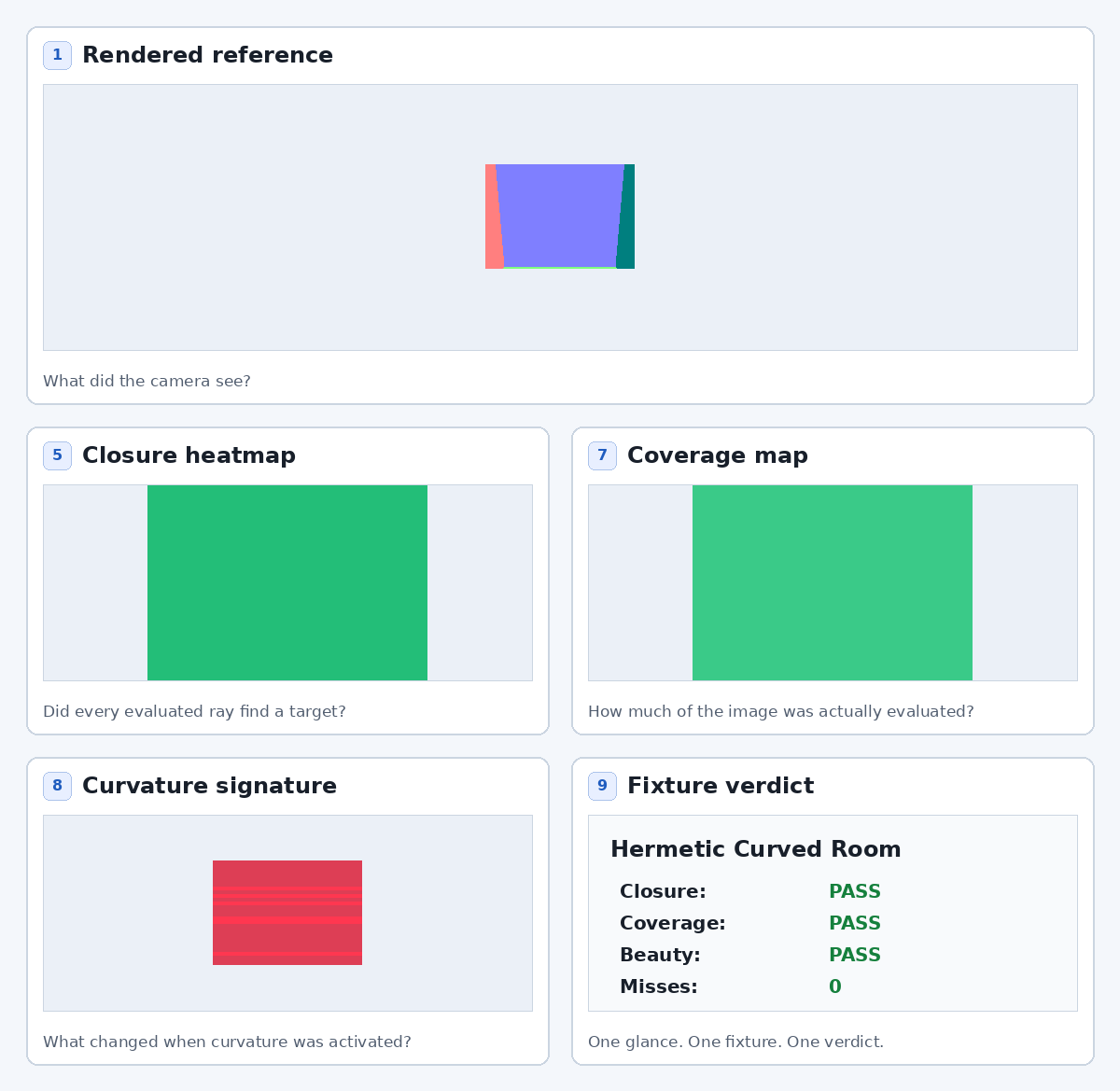
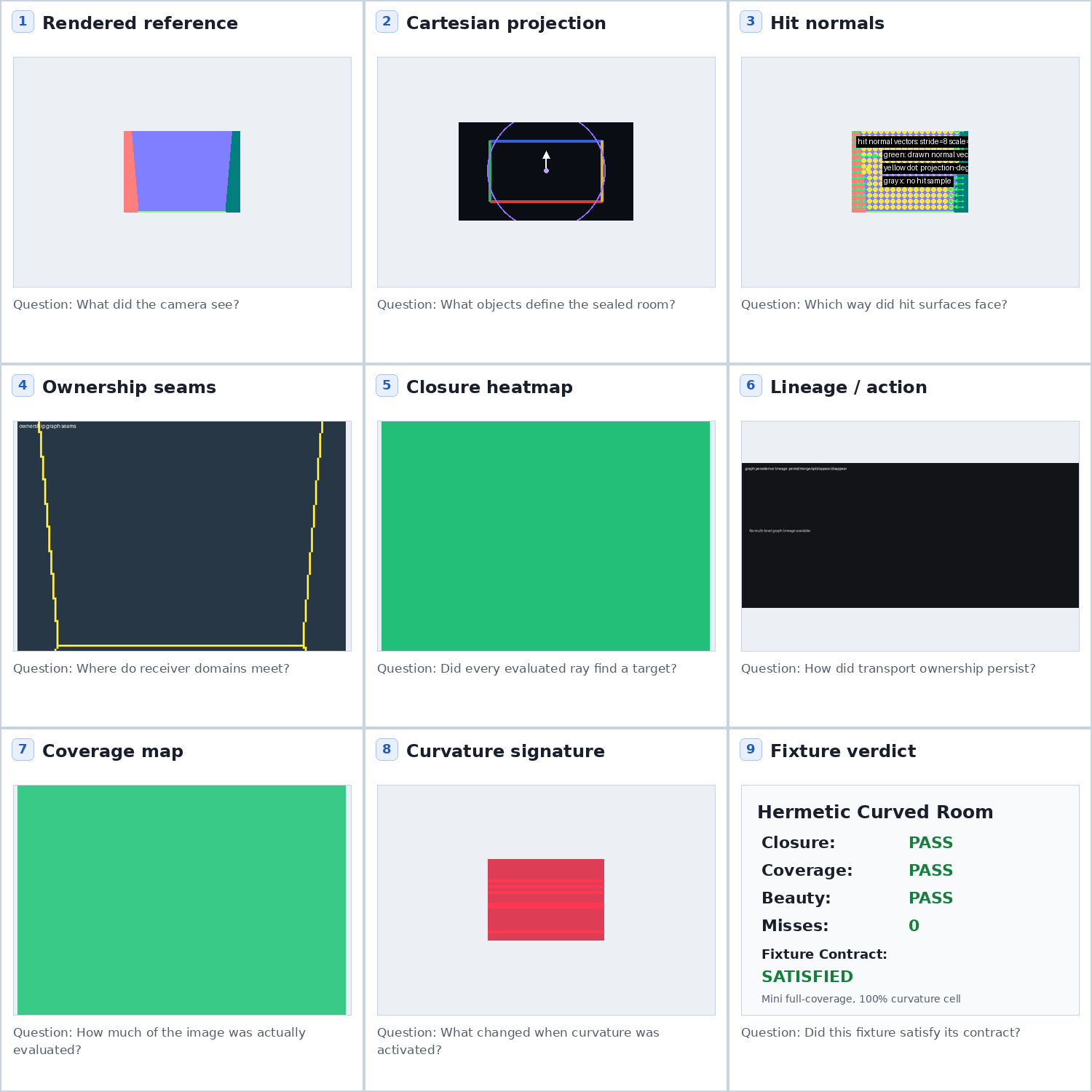
Hermetic Storyboard v2 shows the full validation chain for the sealed-room fixture: rendered reference, geometry, transport, seams, closure, coverage, curvature signature, and final fixture verdict. It confirms scene-contract completion for this fixture; it does not claim physical ground truth.
Detailed 3×3 view: Hermetic Storyboard v2.
Read the scope first in What the Observatory Measures, compare fixture roles in Canonical Fixtures, and see the latest mini full-coverage benchmark comparison in Curvature Full-Coverage Mini Experiment.
The canonical image: Two renders of the identical curved-room scene.
- Left: low integration budget (e.g. 32 steps) — visually plausible.
- Right: high budget (e.g. 700 steps) — visually nearly identical.
- Instrument: closure percentage + budget-exhaustion heatmap.
At low budget the closure can be 0.0% — every pixel is unresolved noise that happens to look like a render. At sufficient budget it reaches 100.0%.
100.0% closure means every pixel was classified within the scene contract, not that the classification is physically accurate.
The red/green accent strips and the closure status map are the only reliable indicators. The eye cannot tell.
Key Artifacts
output/hermetic_hit_closure/(multiple timestamped runs, including 3-panel and storyboard variants).visuals/hermetic-closure-hero.png,hermetic-closure-hero-3panel.png,hermetic-closure-hero-web.png.- Hermetic fixture rule documentation.
Falsifiable Claims
- At the documented production step length and scene, closure at budget X must be ≥ Y%.
- Below the cliff, closure must collapse to near zero.
- Failures must spatially correlate with high-curvature zones (field boundaries, corners).
Related Closure & Hermetic Diagnostics
- Hermetic Hit Closure Recovery and Storyboard sequences.
- Budget exhaustion heatmaps tied to specific fixtures (curved room, domain stress).
- Graceful shutdown probes (what happens to closure when the harness is interrupted).
Exhibit Design Notes
- Always present the plausible image first, then the instrumented closure measurement.
- Use side-by-side with the closure metric overlay.
- Include the exact scene + step + budget parameters so visitors can reproduce the falsification.
Connection to Other Sections
- The ladders in Curvature Benchmark explain why certain regions require high budgets.
- Canonical fixtures (especially Hermetic Curved Room and Boundary Shells) are the repeatable test beds for closure.
- Failures in closure often appear as banding or unresolved islands in the research fixtures.
This section is the heart of the scene-contract philosophy: without the closure contract, every beautiful image is an unverified story — there is no evidence that pixels reached terminal classification rather than stopping mid-journey.