Chapter 2 — Observer Disagreement
Act I — Seeing · Requires Ch 1 concept · Measurement chapter
Core Question
How much does the choice of transport model change what the observer sees — and in which direction does the error go?
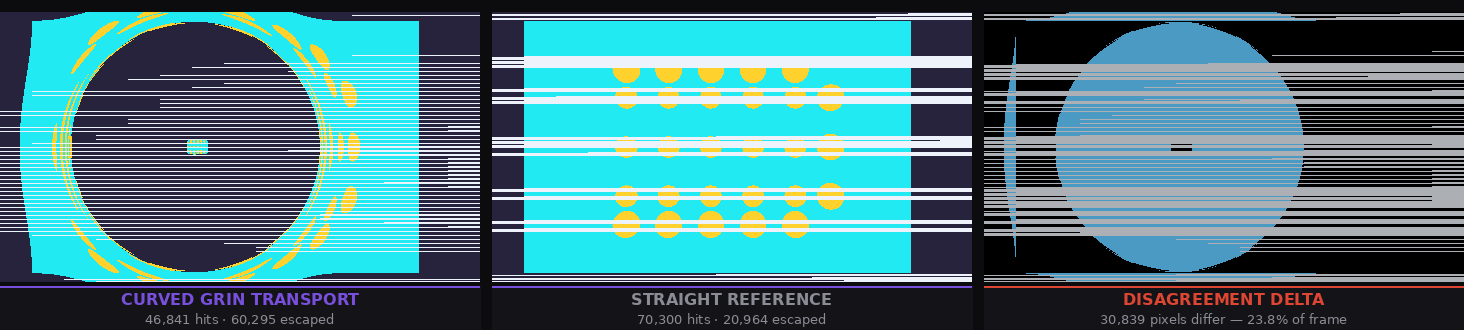
output/observer_disagreement/offaxis_observe_delta/What to look at
Inspect: The disagreement delta panel (right). Look at the color balance — how much blue vs. cyan? The 9:1 ratio toward blue tells you the GRIN field is defocusing, not focusing.
Contradiction: A first guess might be "curved light bends toward objects, so you'd see more hits." The data says the opposite: 27,619 hits became escapes; only 3,220 escapes became hits. Curved transport removes surface contacts in this configuration.
What would make it stronger: A second camera pose at a different off-axis angle — if the disagreement fraction changes with pose, the asymmetry is pose-dependent, not an intrinsic field property. (This sweep is the missing artifact for Chapter 2.)
What the Visitor Sees
Curved GRIN render (left): 46,841 geometry hits, 60,295 escaped, 22,464 budget exhausted. Fewer surface contacts than the straight renderer because curved rays are deflected around geometry by the GRIN field.
Straight reference render (center): 70,300 geometry hits, 20,964 escaped, 38,336 budget exhausted. Straight rays find geometry that curved rays miss. The geometry hit count is 50% higher.
Disagreement delta (right): 30,839 pixels (23.8% of 129,600 total) classify differently. Color encoding:
| Color | Transition | Count | Meaning |
|---|---|---|---|
| Bright blue | geom_hit → escaped |
27,619 | GRIN deflected the ray away from a surface it would have hit |
| Faint cyan | escaped → geom_hit |
3,220 | GRIN deflected the ray toward a surface it would have missed |
| Gray | unresolved | — | Budget exhausted in at least one transport |
| Transparent | unchanged | — | Same classification in both |
The 9:1 ratio (blue to cyan) is the key finding. The GRIN field in this configuration is a defocusing lens: it predominantly redirects rays away from geometry, increasing escape rate rather than increasing surface contact rate.
The Numbers
From the promoted dataset (misterylabs_artifacts/datasets/observer-disagreement.json):
changed_pixels:   30,839
changed_ratio:    0.2380  (23.80%)
dominant_transition: geom_hit → escaped_no_hit
dominant_count:   27,619  (89.6% of all changed pixels)
reverse_count:     3,220  (10.4% of all changed pixels)
asymmetry_ratio:    8.6:1
A straight renderer would report 70,300 geometry hits for this scene. xPRIMEray's curved transport reports 46,841 — a 33% shortfall. The difference is not noise or aliasing. It is the physics of curved rays deflecting past surfaces.
Artifacts
| Artifact | File | Notes |
|---|---|---|
| Contact sheet (1600×1300) | misterylabs_artifacts/visuals/observer-disagreement-contact-sheet.png |
Primary exhibit image |
| Observability cutsheet | misterylabs_artifacts/visuals/observer-disagreement-observability.png |
Surface visibility by transport |
| Pixel counts (JSON) | misterylabs_artifacts/datasets/observer-disagreement.json |
Machine-readable reference values |
| Card | misterylabs_artifacts/cards/observer-disagreement.md |
Ready for MisterY Labs |
| Source report | output/observer_disagreement/offaxis_observe_delta/classification_delta_summary.json |
Full per-class classification data |
Sample World
observer_disagreement_world — design proposal
Scenes: test-grin-basic-visual-minimal-offaxis-observe.tscn + test-grin-basic-visual-straight-offaxis-observe.tscn
The world provides a three-mode toggle: curved / straight / disagreement delta. The Validation HUD shows live classification counts that the visitor can compare to the reference values above. The world is self-validating: approximately 30,839 blue-tinted pixels in disagreement mode reproduces the experiment.
Build priority: 2.
Validation Question
At this camera pose and transport configuration, what should the dominant disagreement transition be — and in which direction?
Expected: geom_hit → escaped_no_hit (27,619 pixels, ~90% of changed pixels).
Falsification condition: If escaped → geom_hit dominates, the GRIN field is acting as a focusing lens in this configuration — unexpected, and worth investigating.
Quantitative gate: Total disagreement should be between 20% and 28% of pixels. Below 5% or above 40% indicates scene or transport configuration mismatch.
Key Insight
Curved transport does not just distort images — it selectively removes surface contacts, with a strong directional asymmetry. The GRIN field in this configuration is a defocusing lens: 9 pixels lost geometry contact for every 1 that gained it.
Next Chapter
Chapter 3 — Hermetic Closure →: Chapters 1 and 2 showed that curved and straight transport produce measurably different results. Chapter 3 asks: how do we know the curved result is correct, rather than just differently wrong?
Bridge: "We've measured the disagreement. Now: how do we verify the curved version is right?"