Observer Ladder Clustering Summary
Source artifact: checkpoint_sequence_summary.json
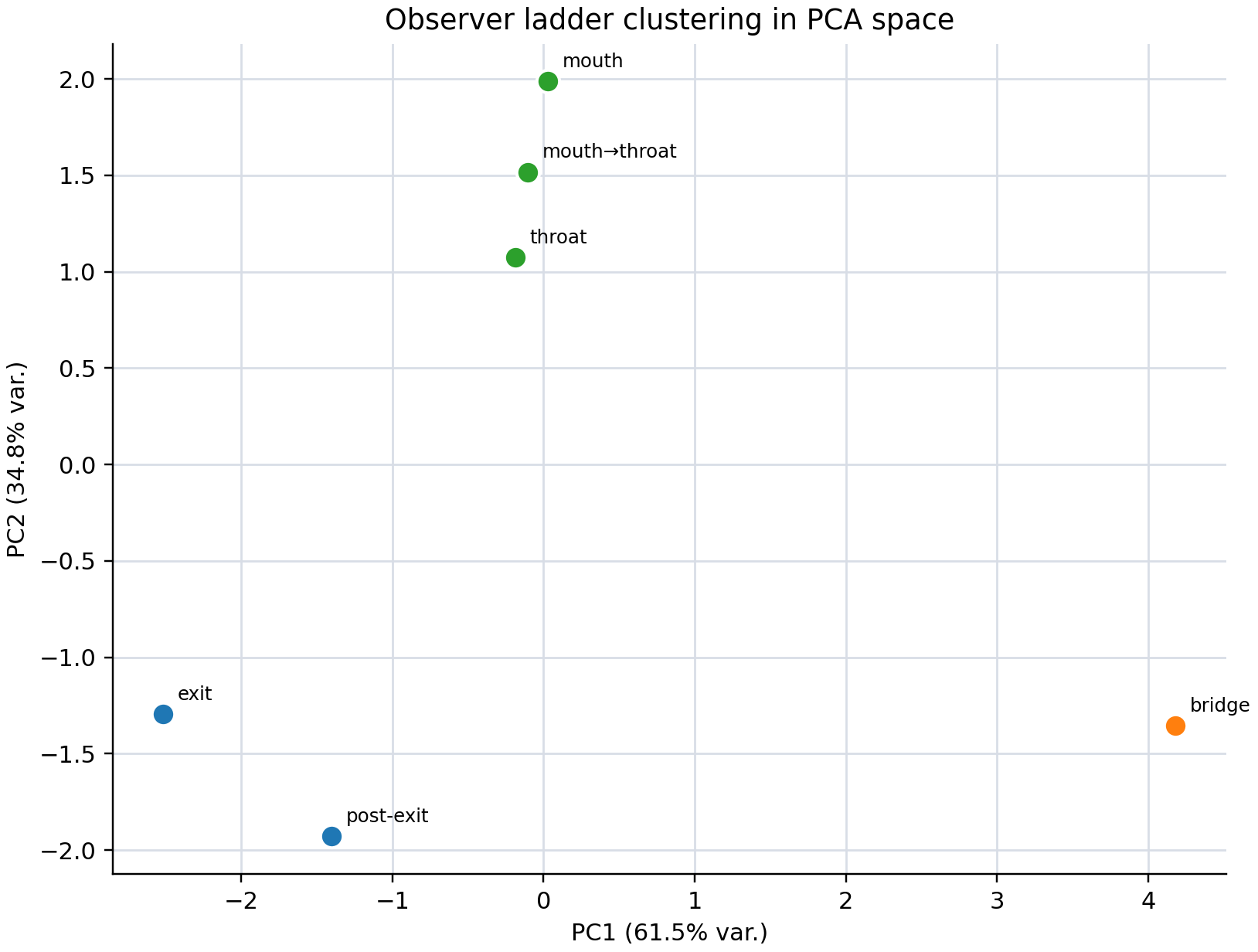
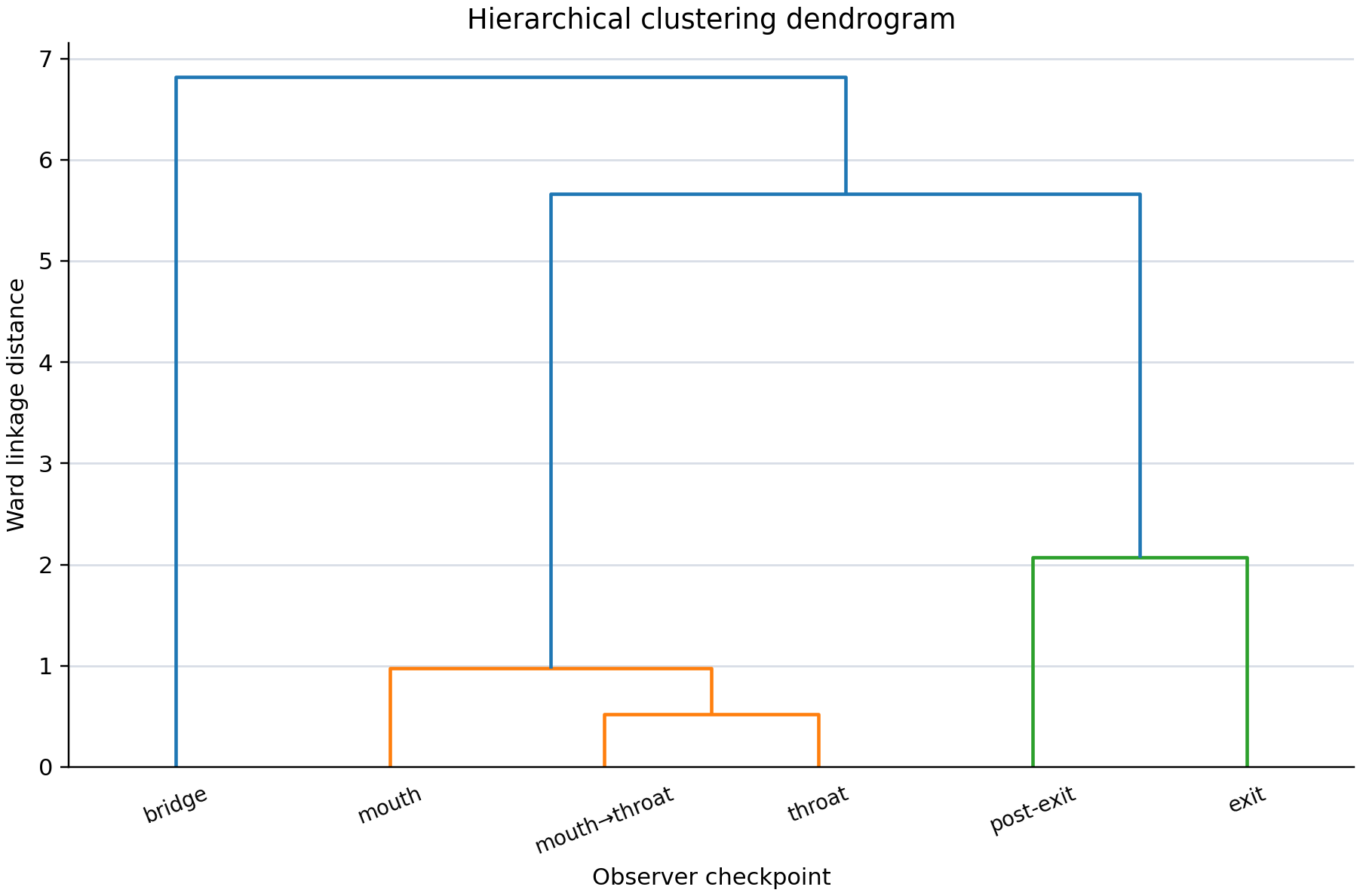
This analysis uses only the saved wormhole ladder checkpoint summary. Features were standardized before clustering.
Checkpoint Feature Table
| Checkpoint | Manual regime | Discovered cluster | OPL mean | OPL max | portal_hit_density | throat_event_density | crossings_per_pixel | segments_per_crossing | AverageSegmentsPerRay |
|---|---|---|---|---|---|---|---|---|---|
mouth |
near-side |
cluster_2 |
9.9599 | 15.8071 | 0.1465 | 0.0969 | 0.6495 | 153.2590 | 99.5403 |
mouth_to_throat_approach |
near-side |
cluster_2 |
9.7287 | 15.5162 | 0.1633 | 0.1048 | 0.6987 | 139.6225 | 97.5569 |
throat |
throat |
cluster_2 |
9.5078 | 15.1926 | 0.1750 | 0.1139 | 0.7479 | 128.1728 | 95.8566 |
post_throat_backstep_01 |
bridge |
cluster_1 |
7.5908 | 12.2611 | 0.0964 | 0.0555 | 0.2098 | 366.0292 | 76.7983 |
post_throat_exit_approach |
far-side |
cluster_0 |
8.1171 | 14.8980 | 0.1798 | 0.2111 | 1.6544 | 50.3105 | 83.2336 |
exit_lookback |
far-side |
cluster_0 |
8.4337 | 16.3070 | 0.2557 | 0.2198 | 1.4200 | 60.9614 | 86.5624 |
Clustering Comparison
| Method | k | ARI vs manual labels | Silhouette |
|---|---|---|---|
agglomerative |
2 | 0.1429 | 0.4320 |
agglomerative |
3 | 0.5946 | 0.5547 |
agglomerative |
4 | 0.2857 | 0.4020 |
agglomerative |
5 | -0.0976 | 0.1067 |
kmeans |
2 | 0.1429 | 0.4320 |
kmeans |
3 | 0.5946 | 0.5547 |
kmeans |
4 | 0.2857 | 0.4020 |
kmeans |
5 | -0.0976 | 0.1067 |
Interpretation
- The best alignment with the current manual regime labels was
agglomerativeatk=3, withARI=0.5946andsilhouette=0.5547. - The bridge checkpoint
post_throat_backstep_01falls incluster_1with cluster size1. - Bridge outlier verdict:
yes. It is isolated as a singleton cluster under the best-performing automatic clustering pass. - The automatic clustering still groups the near-side mouth approach and throat progression together more strongly than the manual taxonomy separates
throatfrom the rest of the near-side leg.
Figures: