Regime Clustering
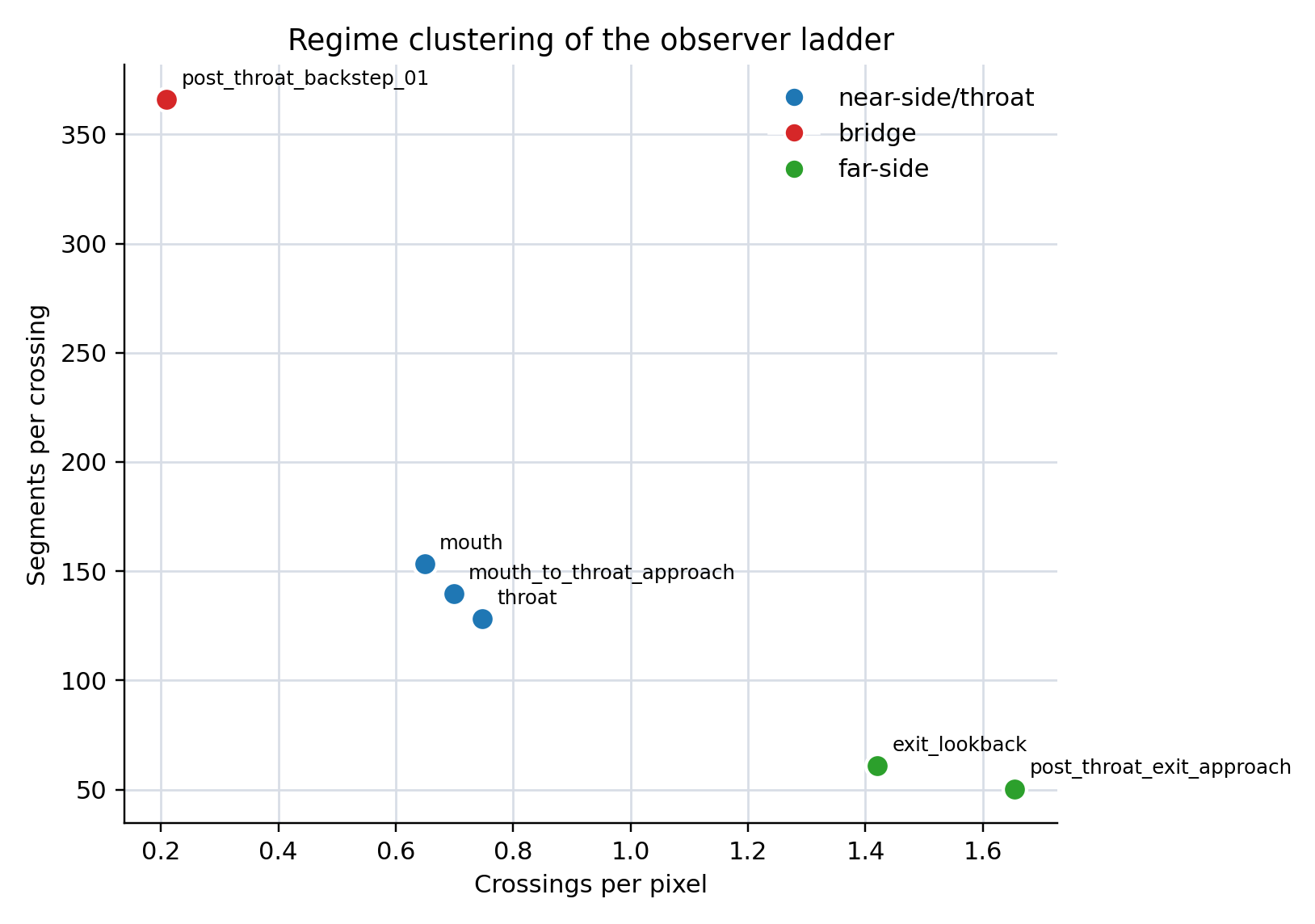
This first-pass clustering uses standardized ladder metrics derived from the frozen checkpoint sequence summary. Inputs are portal-hit density, throat-event density, crossings per pixel, segments per crossing, and OPL mean.
Cluster Table
| Checkpoint | Cluster | portal_hit_density | throat_event_density | crossings_per_pixel | segments_per_crossing | OPL mean |
|---|---|---|---|---|---|---|
mouth |
near-side/throat | 0.1465 | 0.0969 | 0.6495 | 153.2590 | 9.9599 |
mouth_to_throat_approach |
near-side/throat | 0.1633 | 0.1048 | 0.6987 | 139.6225 | 9.7287 |
throat |
near-side/throat | 0.1750 | 0.1139 | 0.7479 | 128.1728 | 9.5078 |
post_throat_backstep_01 |
bridge | 0.0964 | 0.0555 | 0.2098 | 366.0292 | 7.5908 |
post_throat_exit_approach |
far-side | 0.1798 | 0.2111 | 1.6544 | 50.3105 | 8.1171 |
exit_lookback |
far-side | 0.2557 | 0.2198 | 1.4200 | 60.9614 | 8.4337 |
Summary
- The clustering separates a
near-side/throatfamily, a singletonbridgestate, and afar-sidefamily. - The bridge cluster is isolated by low interaction density, low OPL mean, and extremely high segments per crossing.
- The far-side cluster groups the two highest-interaction checkpoints despite their different portal coverage profiles.
Figure: regime_clustering.png